Java实现组合算法的核心思路与实现方法
组合算法是计算机科学中的基础问题,主要从给定集合中选取指定数量的元素,不考虑顺序地生成所有可能的子集,在Java中,实现组合算法可以通过递归、回溯、位运算等多种方式,每种方法各有优劣,适用于不同的应用场景,本文将详细介绍这些方法的实现原理、代码示例及性能分析,帮助开发者根据实际需求选择合适的方案。
递归实现组合算法
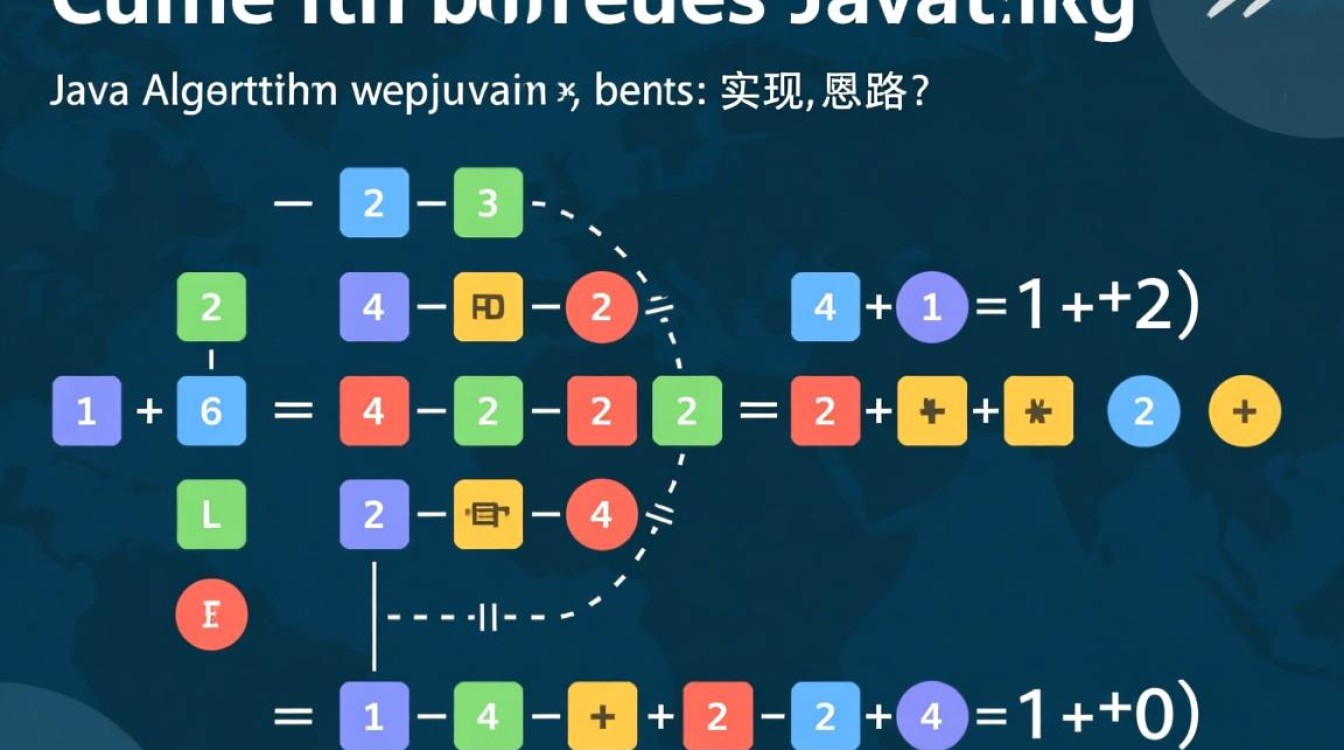
递归是解决组合问题的直观方法,其核心思想是将问题分解为更小的子问题:从n个元素中选取k个元素,可以转化为“选取第i个元素后,从剩余n-1个元素中选取k-1个元素”与“不选取第i个元素,从剩余n-1个元素中选取k个元素”两种情况的组合。
以下是递归实现的Java代码示例:
import java.util.ArrayList;
import java.util.List;
public class CombinationRecursive {
    public static List<List<Integer>> combine(int n, int k) {
        List<List<Integer>> result = new ArrayList<>();
        backtrack(1, n, k, new ArrayList<>(), result);
        return result;
    }
    private static void backtrack(int start, int n, int k, List<Integer> tempList, List<List<Integer>> result) {
        if (k == 0) {
            result.add(new ArrayList<>(tempList));
            return;
        }
        for (int i = start; i <= n - k + 1; i++) {
            tempList.add(i);
            backtrack(i + 1, n, k - 1, tempList, result);
            tempList.remove(tempList.size() - 1);
        }
    }
    public static void main(String[] args) {
        List<List<Integer>> combinations = combine(4, 2);
        System.out.println(combinations); // 输出: [[1, 2], [1, 3], [1, 4], [2, 3], [2, 4], [3, 4]]
    }
}
代码解析:
combine方法初始化结果列表,并调用backtrack方法开始递归。backtrack方法通过循环遍历可能的起始元素,递归构建组合,并在满足条件时添加结果。- 优化点:循环终止条件为
i <= n - k + 1,避免无效递归,减少计算量。
优点:逻辑清晰,易于理解;缺点:递归深度较大时可能导致栈溢出,且重复创建对象影响性能。
回溯法优化组合算法
回溯法通过“选择-撤销-选择”的机制,在递归基础上优化了空间和时间效率,与递归不同,回溯法通过剪枝策略提前终止无效路径,减少不必要的计算。

以下是回溯法的Java实现:
import java.util.ArrayList;
import java.util.List;
public class CombinationBacktracking {
    public static List<List<Integer>> combine(int n, int k) {
        List<List<Integer>> result = new ArrayList<>();
        boolean[] used = new boolean[n + 1];
        backtrack(1, n, k, new ArrayList<>(), used, result);
        return result;
    }
    private static void backtrack(int start, int n, int k, List<Integer> tempList, boolean[] used, List<List<Integer>> result) {
        if (tempList.size() == k) {
            result.add(new ArrayList<>(tempList));
            return;
        }
        for (int i = start; i <= n; i++) {
            if (!used[i]) {
                used[i] = true;
                tempList.add(i);
                backtrack(i + 1, n, k, tempList, used, result);
                used[i] = false;
                tempList.remove(tempList.size() - 1);
            }
        }
    }
    public static void main(String[] args) {
        List<List<Integer>> combinations = combine(4, 2);
        System.out.println(combinations);
    }
}
代码解析:
- 使用
used数组标记元素是否被选中,避免重复选择。 - 通过
tempList.size() == k判断是否达到组合长度,直接添加结果。 - 剪枝策略:循环从
start开始,确保组合元素按升序排列,避免重复。
优点:通过剪枝减少递归次数,效率高于纯递归;缺点:需要额外空间存储used数组。
位运算实现组合算法
当集合规模较小时(如n ≤ 32),可以利用位运算的高效性实现组合算法,基本思路是:用n位二进制数表示元素的选取状态,遍历所有可能的2^n种状态,筛选出其中恰好k个1的组合。
以下是位运算的Java实现:

import java.util.ArrayList;
import java.util.List;
public class CombinationBitwise {
    public static List<List<Integer>> combine(int n, int k) {
        List<List<Integer>> result = new ArrayList<>();
        int total = 1 << n; // 2^n
        for (int mask = 0; mask < total; mask++) {
            if (Integer.bitCount(mask) == k) {
                List<Integer> combination = new ArrayList<>();
                for (int i = 0; i < n; i++) {
                    if ((mask & (1 << i)) != 0) {
                        combination.add(i + 1);
                    }
                }
                result.add(combination);
            }
        }
        return result;
    }
    public static void main(String[] args) {
        List<List<Integer>> combinations = combine(4, 2);
        System.out.println(combinations);
    }
代码解析:
total = 1 << n表示所有可能的子集数量。Integer.bitCount(mask)统计二进制数中1的个数,筛选出k个1的组合。- 通过
mask & (1 << i)判断第i位是否为1,确定元素是否被选中。
优点:代码简洁,运算速度快;缺点:仅适用于n较小的情况,大数时位运算效率下降。
性能对比与适用场景
| 方法 | 时间复杂度 | 空间复杂度 | 适用场景 |
|---|---|---|---|
| 递归 | O(C(n,k)) | O(k) | 小规模数据,逻辑简单 |
| 回溯法 | O(C(n,k)) | O(n) | 中等规模数据,需要剪枝优化 |
| 位运算 | O(n * 2^n) | O(k) | n ≤ 32,追求极致性能 |
选择建议:
- 若数据规模小(n < 20),优先选择递归或位运算;
- 若数据规模较大(n ≥ 20),回溯法是更优解;
- 对性能要求极高且n较小时,可考虑位运算。
Java实现组合算法的方法多样,开发者需根据实际需求权衡代码可读性、时间复杂度和空间复杂度,递归适合快速实现,回溯法在效率和通用性之间取得平衡,而位运算则在特定场景下展现极致性能,通过理解这些方法的原理,可以灵活应对组合问题的不同挑战,为实际开发提供高效解决方案。